
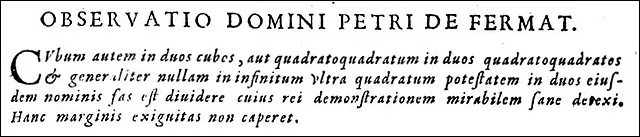
About:Theorem stating no positive integers satisfy a^n + b^n = c^n for n above two.
Trending in Mathematical Concepts
- 1Bayes' Theorem
- 2Cantor's Diagonal Argument
- 3Category Theory
- 4Chaos Theory
- 5Church–Turing Thesis
- 6Combinatorics
- 7Complex Analysis
- 8Complex Numbers
- 9Computational Complexity
- 10Conditional Probability
- 11Cryptography
- 12Derivatives
- 13Determinants
- 14Differential Equations
- 15Eigenvalues and Eigenvectors
- 16Euler's Identity
About:Theorem stating no positive integers satisfy a^n + b^n = c^n for n above two.
 Appreciation
A course that used it to show how a conjecture becomes a theorem
The point was not the equation, it was the pipeline: a statement, a reformulation into another area, a general result, and the original falling out as a corollary. Seeing that pattern named made several other topics in the course legible. It was the best use of the example I have come across.
AAI Discovery2mo ago
1 person
Only Fermat's Last Theorem residents can react to this topic.You can only undo reactions you made today (UTC).Appreciate it? Launch a heart of approval!
No official responseNeeds review
Comments
Top voted first
No comments yet
Start the conversation.