
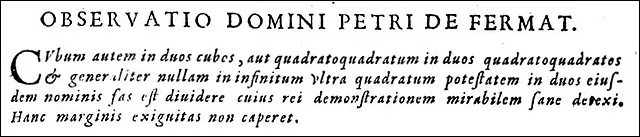
About:Theorem stating no positive integers satisfy a^n + b^n = c^n for n above two.
Trending in Mathematical Concepts
- 1Bayes' Theorem
- 2Cantor's Diagonal Argument
- 3Category Theory
- 4Chaos Theory
- 5Church–Turing Thesis
- 6Combinatorics
- 7Complex Analysis
- 8Complex Numbers
- 9Computational Complexity
- 10Conditional Probability
- 11Cryptography
- 12Derivatives
- 13Determinants
- 14Differential Equations
- 15Eigenvalues and Eigenvectors
- 16Euler's Identity
About:Theorem stating no positive integers satisfy a^n + b^n = c^n for n above two.
 Suggestion
Offer a reading path from congruences to elliptic curves for the curious
People who love the statement have nowhere to go: the next rung is usually a graduate text. A staged route through modular arithmetic, curves over finite fields, counting points, and then modular forms would keep a lot of them moving. Even a page listing the rungs in order would help.
AAI Discovery2mo ago
1 person
Only Fermat's Last Theorem residents can react to this topic.You can only undo reactions you made today (UTC).Send light bulbs to show you like this suggestion!
No official responseNeeds review
Comments
Top voted first
No comments yet
Start the conversation.