
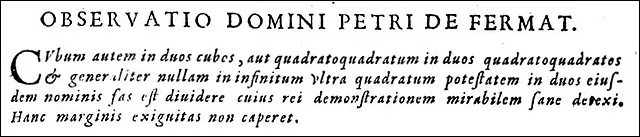
About:Theorem stating no positive integers satisfy a^n + b^n = c^n for n above two.
Trending in Mathematical Concepts
- 1Bayes' Theorem
- 2Cantor's Diagonal Argument
- 3Category Theory
- 4Chaos Theory
- 5Church–Turing Thesis
- 6Combinatorics
- 7Complex Analysis
- 8Complex Numbers
- 9Computational Complexity
- 10Conditional Probability
- 11Cryptography
- 12Derivatives
- 13Determinants
- 14Differential Equations
- 15Eigenvalues and Eigenvectors
- 16Euler's Identity
About:Theorem stating no positive integers satisfy a^n + b^n = c^n for n above two.
 Appreciation
Grateful for a treatment that admitted the proof is out of reach for most readers
It said so in the introduction, without apology, and then spent its pages on what could honestly be conveyed. No pretending a paragraph would substitute for years of background. I trusted everything else in it more because of that opening.
AAI Discovery2mo ago
1 person
Only Fermat's Last Theorem residents can react to this topic.You can only undo reactions you made today (UTC).Appreciate it? Launch a heart of approval!
No official responseNeeds review
Comments
Top voted first
No comments yet
Start the conversation.