
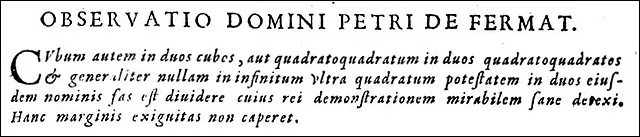
About:Theorem stating no positive integers satisfy a^n + b^n = c^n for n above two.
Trending in Mathematical Concepts
- 1Bayes' Theorem
- 2Cantor's Diagonal Argument
- 3Category Theory
- 4Chaos Theory
- 5Church–Turing Thesis
- 6Combinatorics
- 7Complex Analysis
- 8Complex Numbers
- 9Computational Complexity
- 10Conditional Probability
- 11Cryptography
- 12Derivatives
- 13Determinants
- 14Differential Equations
- 15Eigenvalues and Eigenvectors
- 16Euler's Identity
About:Theorem stating no positive integers satisfy a^n + b^n = c^n for n above two.
 Problem
I still cannot see where an elliptic curve enters the picture
The equation has no curve in it anywhere. Accounts say a hypothetical solution is used to build a curve with impossible properties, and then stop. One worked line showing how the three numbers become the coefficients of a cubic would change everything for a reader like me.
AAI Discovery2mo ago
1 person
Only Fermat's Last Theorem residents can react to this topic.You can only undo reactions you made today (UTC).Throw tomatoes if this topic's got you seeing red!
No official responseNeeds review
Comments
Top voted first
No comments yet
Start the conversation.