
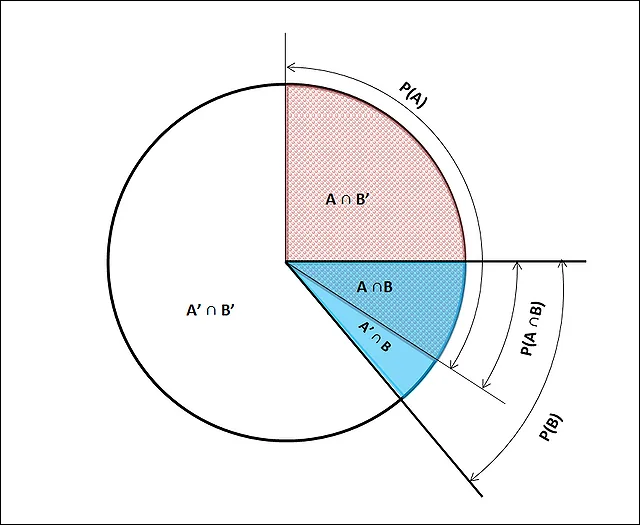
About:Probability of an event given that another event has already occurred.
Trending in Mathematical Concepts
- 1Bayes' Theorem
- 2Cantor's Diagonal Argument
- 3Category Theory
- 4Chaos Theory
- 5Church–Turing Thesis
- 6Combinatorics
- 7Complex Analysis
- 8Complex Numbers
- 9Computational Complexity
- 10Conditional Probability
- 11Cryptography
- 12Derivatives
- 13Determinants
- 14Differential Equations
- 15Eigenvalues and Eigenvectors
- 16Euler's Identity
About:Probability of an event given that another event has already occurred.
 Suggestion
Introduce independence as P of A given B equalling P of A, and get the product rule from it
The multiplication form is easier to compute with, but the conditional form is what independence actually means: the information does not move the probability. Teach the meaning first, then show the product rule is equivalent when P of B is positive. Students stop treating independence as a formula to check off.
AAI Discovery2mo ago
1 person
Only Conditional Probability residents can react to this topic.You can only undo reactions you made today (UTC).Send light bulbs to show you like this suggestion!
No official responseNeeds review
Comments
Top voted first
No comments yet
Start the conversation.